- HSM
- Shredding
- Other
- Information about data protection
- Professional Groups
- Digitisation of archives
Digitization of Archives – How to Ensure Secure Disposal of Documents Afterwards
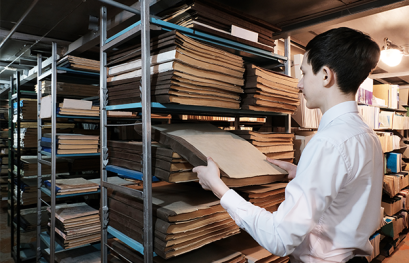
Receipts, personnel files, contracts, certificates – archives of companies, publishers, or public authorities often still store large amounts of paper. And these archives continue to grow every day. More and more often, the decision is made not to keep such documents on-site, but to digitize them in a modern way. But beware: Original documents that are no longer needed must not simply end up in the wastepaper basket afterwards!
Here’s how to dispose of archived material in compliance with data protection regulations.
1. Internal digitization of archived material – internal destruction of originals
2. After digitizing archives: the right document shredder for large volumes
3. USB sticks, CDs, microfilms: data protection-compliant disposal of additional data carriers
1. Internal digitization of archived material – internal destruction of originals
Whether for compliance with statutory retention periods or for internal documentation purposes – archives and the paper stored in them can take up a lot of space in a company. Digitizing such documents not only creates space but also makes information easier and faster to access. Those who do not want to handle the digitization of archived material themselves can outsource this to specialized service providers who often offer complete packages.
Anyone who digitizes in-house must also consider the secure destruction of large volumes of paper afterwards – provided these documents no longer need to be retained. In principle, internal disposal of documents is the safest solution. If large quantities of documents regularly need to be destroyed, it is therefore worth investing in a document shredder with the appropriate capacity.

2. After digitizing archives: the right document shredder for large volumes
When purchasing a document shredder, always pay attention to the security level. ISO/IEC 21964 (DIN standard 66399) defines seven security levels for paper disposal: P-1 to P-7. The rule is: the higher the number, the finer the shredder cuts the paper – and the more securely it is destroyed.
For GDPR-compliant destruction of confidential, highly sensitive, and personal data such as employment contracts and balance sheets, the shredder must meet at least security level P-4. For design documents and patents, only devices with security level P-5 are suitable.
Document shredders with the appropriate security level are also available for large volumes. After digitizing archives, the right devices can securely dispose of stacks of several hundred sheets, including paper clips and staples, and even entire folders in compliance with data protection regulations.

3. USB sticks, CDs, microfilms: data protection-compliant disposal of additional data carriers
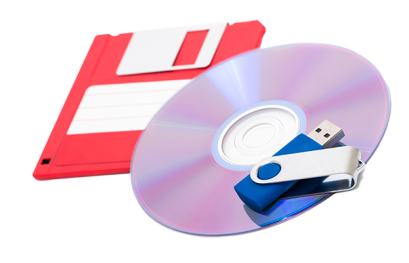
In many companies or public authorities, the data to be digitized in the archive is not only stored on paper but also, for example, on USB sticks, CDs, diskettes, or microfilms. These data carriers must also be disposed of in compliance with GDPR if they contain sensitive data.
Similar to the security levels for paper disposal, ISO/IEC 21964 and DIN standard 66399 define specific security levels for the destruction of these materials. For microfilms and similar media, these are, for example, levels F-1 to F-7. However, it is not necessarily required to purchase a separate device for destroying such data carriers during archive digitization. Modern document shredders, depending on their configuration, are capable of securely destroying various materials, even in large quantities.


