- HSM
- PET Solutions
- Sustainability through PET Recycling
Sustainability through PET recycling
Every year, around 350 million tons of plastic are produced worldwide. This corresponds to approximately ten times the amount of plastic produced 50 years ago. It is therefore only logical that the need for high recycling rates and improved waste management systems should also increase. According to the European Union, more than 80% of the waste that ends up in the oceans is plastic, causing significant harm to the creatures living in it and the environment.
To prevent this, the EU has introduced both a ban on certain single-use plastic products and additional measures to reduce plastic waste.
But it’s not only the EU taking action – in Germany, the sale of plastic bags in supermarkets has been prohibited since 2022. The only exceptions are particularly durable reusable bags and plastic bags for fruit and vegetables.


Even regardless of the measures taken by the EU or individual countries, the topics of sustainability and PET recycling have gained significant importance among both companies and consumers in recent years. PET bottle recycling, in particular, is in the focus of consumers. As beverages are increasingly consumed “on the go”, the share of single-use PET bottles will continue to rise in the future.
The reusable system already plays an important role in sustainability. Thanks to the successful deposit-return system, which is already in place in some European countries, reusable items can be used again and again. This reduces the proportion of newly produced items.
It is not only the reusable system but also the single-use system which contribute to sustainability through PET recycling.
The investment in sustainability and PET recycling is also driven by the increasing customer demand for sustainable single-use solutions. In addition, the EU has set clear regulations for companies regarding plastic recycling through its ban on single-use plastic items, the prescribed collection rate for PET bottles, and the requirement for recycled content in PET bottles.
Above all, due to the EU requirement that PET bottles must consist of at least 25 % recycled plastic from 2026 onwards, pure PET (recyclate) is considered a valuable commodity – a valuable raw material in the recycling cycle.
Through various PET recycling methods, PET bottles are processed into granulate. This granulate is used not only for the production of new PET bottles but also for the manufacture of other products such as textiles, films, or packaging. In this way, new products are created from single-use PET bottles, and the proportion of newly produced plastic decreases.
More and more companies are developing solutions for efficient PET recycling to comply with legal regulations and improve sustainability and environmental protection. Today, a proportion of new PET bottles already consist of 100 % recyclates and are therefore made entirely from reused plastic. This aims to achieve the long-term goal of producing less plastic and significantly reducing environmental pollution.
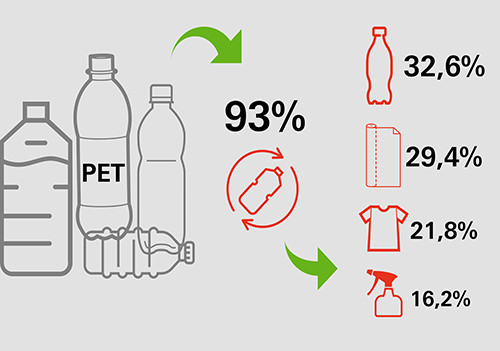
Reuse of PET bottles


