- HSM
- Shredding
- Other
- Information about data protection
- Office organization
- Office Organisation Tips
Office organisation: tips for a tidy workplace
As is so often the case in life, organisation is also the key to success in the office. In doing so, the endeavour to create organisation in the workplace can become a great task. It is therefore better to no allow any disorder from arising. Our tips to support you in office organisation.
Organisation in the office: you must overcome these obstacles
One thing is clear, even in the office: there must be organisation. A clear storage structure is indeed extremely important, particularly in the office. It is only in this way that deadlines can be maintained, important customer meetings are organised and executed, and documents can be retrieved.
As a result, there are three areas within office organisation that you should pay particular attention to.

Tip #1: Organisation in the office through time management
The proverb “time is money” is not for nothing. So that a company can run smoothly, all work processes should be designed to be as effective and efficient as possible. This saves time and resources.
As a result, time planning is among the most important tools for organisation in the workplace. Offices normally have a (virtual) calendar system in which the important appointments and deadlines are entered. In addition, it is important that the employer provides employees with sufficient time to organise the office. This not only includes putting cups into the dishwasher at the end of the day. However, includes the updating of data and the storing of documents with adequate time.
Tip #2: Organisation of the desk thanks to the thought-out storage systems
Another challenge regarding organisation in the office: storage of documents and files. Here, a suitable storage system aids organisation. In the workplace in the office, not only digital data, but still a great number of files in paper format arise. The following strategies have been tried and tested to sort files in the office and to organise the documents:
- folder systems with multi-coloured portfolios and file foils
- different storage compartments or trays for sorting incoming documents
- careful labelling of folders and storage compartments, and the use of colour systems

Tip #3: Organise the office with the help of software solutions
Due to the advancing digitalisation, many offices are setting less on analogue, available files and data. Instead, it pays to invest in intelligent software that makes organisation easier. Thus, the need to sort files in the offices can be prevented to a great extent and the work environment is designed to be as paper-free as a possible.
Software solutions, such as Microsoft Outlook, Office 365 and Google Workspace frequently form the basis for organisation in the workplace. Offices count on these programs because they enable organised work for each and every employee alone or within the team, and simplify communication with customers. In addition, nowadays there is additional software for almost every company that makes work and office organisation easier - whether it be a program for appointment allocation in medical centres or architect software for construction documentation.

Organisation in the office at home
High paper stacks that blow over with the threat of the slightest breeze should be avoided, even in a home office. Make sure that you have organisation in the office at home. Storage systems that already exist there should be maintained as best as possible. You must also observe data protection in the home office when handling sensitive data! Here you can find out more about data protection in the home office.
Included in office organisation both in the office and at home is the proper disposal of files and data carriers. Here there are likewise rules that must be adhered to.
Organise office storage with document shredders by HSM
When tidying the office, discarded and filed documents cannot be simply hoarded in a storage room until the space is inadequate and you are forced to find another solution. A good filing system makes it immediately visible which documents can be destroyed and when.
This is particularly important because the German legislator stipulates how long data must be stored, in detail, via the General Data Protection Regulation (GDPR). This retention period varies depending on the document type. If the term has expired, files and data carriers can be disposed properly.
With shredding we instantly think of paper documents, which are passed through a shredder. At the same time, nowadays data destruction can be somewhat more complicated. For a long time, companies are not exclusively counting on documents in paper format. Therefore, included in the tidy up of the archive is the proper disposal of visual, magnetic and electronic data carriers or hard disks.

Destroying analogue, archived documents
Files of paper in which data is filed must not simply be disposed of in a paper waste basket. Instead, they should be properly shredded. This data shredding can be performed either internally or externally. With external data shredding, the files to be destroyed are collected and handed over to an external service provider. However, the risk always arises that data falls into the wrong hands during transportation. More information about this can be found in our guidebook on internal vs. external data shredding.
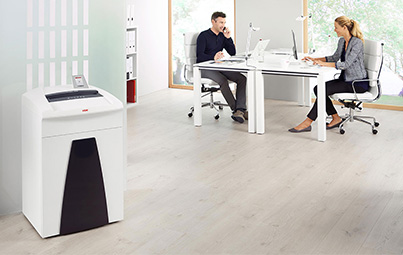
Internal data shredding is therefore recommended. A document shredder at the desk or in an open-plan office enables you to quickly and easily destroy paper files. Thus you achieve the highest degree of data protection and are able to simultaneously organise storage in your office.
There are different document shredders available depending on the size of the office. For a small office in which one to three people use the shredder, we would recommend the energy-saving HSM SECURIO C16. Discover other smart document shredders for small to medium-sized offices, as well as for open-plan offices and whole departments.

Office organisation through the disposal of digital data carriers and storage media:
Even discarded digital storage media must not simply be disposed of in the household waste, particularly is sensitive data is stored on it.
Included among the most accessible digital data carriers and storage media:
• optical media (e.g. CDs)
• magnetic media (e.g. floppy disks, swipe cards)
• electronic data media (e.g USB sticks, chip cards)
• hard disks
Easily ensure organisation in the office
Most people spend about forty hours per week in the office or home office. It is therefore even more important that this is a pleasant workspace in which you feel comfortable. An organised and tidy workplace plays a significant role in this and also enables more efficient and economical work.
Factors that ensure a tidy office are correct time management, good document storage and folder structure, as well as the appropriate software. For office organisation it also is extremely important that documents and discarded data carriers are properly disposed. The qualitative, high-quality and practical document and media shredders by HSM can support you with this.